
Thematic Analysis with AI-Generated Transcripts: A Six-Phase Workflow
By the YumiLM Team
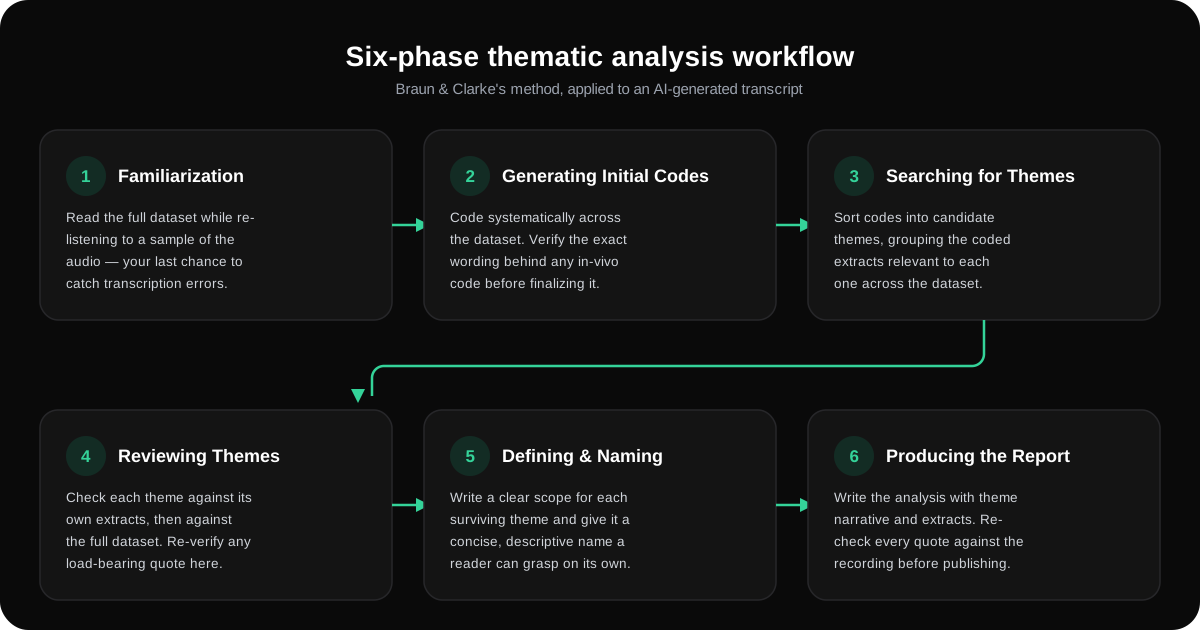
Thematic analysis is a method for identifying, analyzing, and reporting patterns of meaning across a dataset — most commonly through a widely used six-phase approach described by Braun and Clarke in 2006. This guide walks through those six phases specifically when your starting material is an AI-generated interview or video transcript, where the dataset arrives faster than usual but carries its own preparation risks before analysis can begin.
For the general codebook-building, inter-coder reliability, and audit-trail practices that thematic analysis shares with other coding approaches, see How to Analyze Interview Transcripts — this guide focuses on what's specific to the six-phase thematic method and to AI-transcript input, and links back there rather than repeating that ground.
Key Takeaways
| Phase | What changes when the input is an AI transcript |
|---|---|
| 1. Familiarization | Re-listen while reading — don't treat the transcript as a substitute for the audio on first pass |
| 2. Generating initial codes | Verify any segment before coding it, especially where wording drives the code |
| 3. Searching for themes | Unaffected by transcript source — this is pattern-recognition across your codes |
| 4. Reviewing themes | Re-check candidate themes against the full dataset, not just your code list |
| 5. Defining and naming themes | Unaffected by transcript source |
| 6. Producing the report | Confirm any quoted extract matches the source recording exactly before publishing it |
Table of Contents
- What thematic analysis is
- Transcript readiness before you begin
- Phase 1: Familiarizing yourself with the data
- Phase 2: Generating initial codes
- Phase 3: Searching for themes
- Phase 4: Reviewing themes
- Phase 5: Defining and naming themes
- Phase 6: Producing the report
- Example workflow, start to finish
- AI-assisted vs. researcher-led analysis
- Limitations and interpretation risks
- Privacy and confidentiality considerations
- Checklist
- Sources
What thematic analysis is
Thematic analysis identifies patterns ("themes") across a dataset that capture something meaningful in relation to the research question. It's flexible with respect to theoretical framework — usable inductively (themes emerging from the data) or deductively (coding against an existing framework) — which is part of why it's one of the most widely used qualitative methods across disciplines. Braun and Clarke's six phases give it a repeatable, teachable structure without locking the researcher into a single theoretical position.
Transcript readiness before you begin
Thematic analysis is only as trustworthy as the transcript it's built on. If your transcript came from an AI transcription tool, run it through a verification pass before Phase 1 — checking speaker attribution, flagging uncertain segments, and deciding your cleanup convention. That preparation problem is covered in full in Coding AI-Generated Interview Transcripts; treat it as a prerequisite step to this guide, not something to solve mid-analysis.
Phase 1: Familiarizing yourself with the data
Familiarization means reading the entire dataset repeatedly, actively, and with an analytic eye — noting initial impressions before any formal coding starts. With an AI-generated transcript specifically, do this first pass while re-listening to at least a sample of the audio rather than reading the transcript alone. This serves two purposes at once: it's the same immersive first read Braun and Clarke describe, and it's your last practical opportunity to catch transcription errors before they influence which segments feel analytically interesting.
Keep brief notes as you go — early impressions, striking phrases, and anything that seems to recur. These notes become the seed of Phase 2.
Phase 2: Generating initial codes
Work systematically through the dataset, generating codes that identify features of the data relevant to your research question. This is mechanically the same first-cycle coding process described in the general coding guide (open coding, in-vivo coding where the participant's own phrasing matters) — see that guide for the full codebook-construction process, including how to write code definitions and inclusion/exclusion criteria.
The AI-transcript-specific addition: if a code is built directly on a participant's exact wording (in-vivo coding), verify that wording against the source recording before finalizing the code. An in-vivo code is only as reliable as the transcription it's drawn from.
Phase 3: Searching for themes
Once the dataset is coded, sort codes into potential themes, collecting together all the coded extracts relevant to each candidate theme. This is a pattern-recognition step across your own codes and is not affected by whether the transcript came from AI or human transcription — by this stage, any transcription issues should already have been resolved in Phases 1–2.
A useful working distinction at this stage: a theme is not just a summary of a topic participants discussed — it's a pattern that captures something meaningful about the topic in relation to your research question. "Time management" is a topic; "senior researchers experience a structural loss of autonomy over their own time" is closer to a theme.
Phase 4: Reviewing themes
Check candidate themes against two levels: first, do the coded extracts within each theme form a coherent pattern (Level 1)? Second, does the theme hold up against the entire dataset, not just the extracts you originally coded into it (Level 2)? Themes that only work for a handful of extracts, or that collapse into one another on closer inspection, get split, merged, or discarded at this stage.
This is also a good point to re-verify: if a theme rests heavily on a small number of quotes, confirm those specific quotes are transcribed accurately before building further analysis on them — a single misheard word in a load-bearing quote can distort an entire theme.
Phase 5: Defining and naming themes
For each theme that survives review, write a clear definition of its scope — what it captures and what it doesn't — and give it a concise, descriptive name. A good theme name and definition should let a reader understand the analytic point without needing to read every extract underneath it.
Phase 6: Producing the report
Write the analysis, weaving theme narrative together with vivid, compelling extract examples and connecting back to the research question and existing literature. Before publishing any quoted extract, do a final check that the quote matches the source recording exactly — not just the transcript. A misquote that reaches a published report is far more costly to correct than one caught during coding.
Example workflow, start to finish
| Step | Input | Output |
|---|---|---|
| AI transcript generated | Recorded interview | Timestamped, speaker-labeled draft transcript |
| Transcript verification | Draft transcript | Coding-ready, verified transcript |
| Phase 1 — Familiarization | Verified transcript + audio spot-check | Impressions notes |
| Phase 2 — Initial coding | Verified transcript | Preliminary code list |
| Phase 3 — Searching for themes | Coded dataset | Candidate themes with grouped extracts |
| Phase 4 — Reviewing themes | Candidate themes | Refined theme set, checked against full dataset |
| Phase 5 — Defining and naming | Refined themes | Named themes with clear definitions |
| Phase 6 — Producing the report | Named themes + verified extracts | Findings write-up |
AI-assisted vs. researcher-led analysis
Be specific about where AI assistance actually helps in this workflow, because it's a narrower role than it might sound: transcription (turning audio into a timestamped, editable text document) and, where a tool provides one, an early structured overview for orientation. YumiLM's Insight Guide generates that kind of overview — a premise, timestamped sections, and highlighted concepts drawn from the transcript — which can be a useful first read before Phase 1 proper, the same way skimming a table of contents orients you before you start a book.
What AI does not do, and what this workflow doesn't ask it to do: generate your codes, decide which patterns count as themes, judge whether a theme holds up against the full dataset, or write your analytic interpretation. Those six phases remain a researcher-led process from Phase 2 onward — that's not a limitation of any particular tool, it's what thematic analysis is.
Limitations and interpretation risks
A few risks are specific to building thematic analysis on AI-generated transcripts, worth naming directly rather than glossing over:
- Errors compounding into themes. A transcription error that goes uncorrected in Phase 1 or 2 can shape which patterns look salient by Phase 3 — by the time you're grouping codes into themes, it's harder to trace a distorted pattern back to its source. This is the main argument for the verification step before Phase 1, not after a theme is already built.
- Mistaking a structured overview for the analysis. A tool-generated summary (like an Insight Guide) is useful for orientation, but it is not thematic analysis and shouldn't be cited as if it were — it hasn't gone through the coding, theme-development, and validation process this guide describes.
- Over-trusting clean-looking output. As noted in the transcript-preparation guide, AI transcripts tend to read as polished and complete even where they contain errors, which can make researchers less likely to scrutinize them than a rougher human draft. Deliberately building in a verification step counteracts this.
Privacy and confidentiality considerations
Processing interview recordings through any transcription tool — AI-based or human — means participant data leaves its original recording and passes through another system. Before you do this, confirm it's covered by the consent your participants actually gave (does your consent form mention AI-assisted transcription specifically, or only "transcription" generally?), check your institution's data-handling requirements for any tool you use, and anonymize participant names and identifying details before transcripts or extracts are shared outside your immediate research team. These are standard qualitative-research data-handling practices, not something specific to any one transcription tool — apply them regardless of which tool produced the transcript.
Checklist
- Transcript verified (see the AI-transcript preparation guide) before Phase 1 begins
- Familiarization pass included a spot-check against the source audio, not just the transcript text
- Any in-vivo-coded segments verified against the recording before finalizing codes
- Candidate themes reviewed at both the extract level and against the full dataset
- Quotes intended for the final report re-verified against the source recording before publication
- Consent scope confirmed for AI-assisted transcription specifically
- Participant identifying details anonymized before sharing extracts outside the research team
Sources
- Braun, V., & Clarke, V. (2006). Using thematic analysis in psychology. Qualitative Research in Psychology, 3(2), 77–101.
- A practical guide for conducting qualitative research in medical education: Part 2 — Coding and thematic analysis - PMC
Recommended
- How to Analyze Interview Transcripts | YumiLM
- Coding AI-Generated Interview Transcripts | YumiLM
- Verbatim Transcription Accuracy for Interviews | YumiLM
- Transcribe Interviews Faster: A Research-Ready Workflow | YumiLM
- Audit Trail in Qualitative Research | YumiLM
- How to Analyze Focus Group Transcripts | YumiLM
- AI Transcription Guide | YumiLM