
How to Analyze Interview Transcripts: A Research Guide
By the YumiLM Team

A reproducible, research-grade workflow converts raw interview transcripts into defensible findings by moving through six core stages: read and annotate, first-cycle code, build a codebook, develop themes, synthesize across cases, and write up with evidence. Trustworthiness depends on maintaining an audit trail, writing analytic memos throughout, and running inter-coder reliability checks before finalizing themes. Here is what each stage delivers:
-
Read and annotate: Initial impressions memo, margin notes, emerging questions
-
First-cycle coding: A preliminary code list (open or in-vivo codes)
-
Codebook development: Versioned codebook with definitions and example quotes
-
Full coding pass: A coded corpus with all transcripts marked
-
Theme development: Named, bounded theme statements with supporting evidence
-
Synthesis and write-up: A findings narrative with selected exemplar quotes and an audit trail
The Frontiers review on qualitative data analysis confirms that iterative reading, memoing, and repeated coding cycles are central to reaching saturation and producing credible findings.
Key Takeaways
A reproducible interview transcript analysis workflow requires a versioned codebook, an audit trail with documented rationale, and inter-coder reliability checks before themes are finalized.
| Point | Details |
|---|---|
| Match method to research question | Choose inductive approaches for theory-building; deductive for framework testing. |
| Version your codebook | Every code needs a label, definition, inclusion/exclusion criteria, and an example quote. |
| Document every decision | Record date, actor, rationale, and affected files in an audit trail throughout analysis. |
| Verify with multiple tactics | Use member checking, peer debriefing, and Kappa scores above 0.60 to establish trustworthiness. |
| YumiLM for faster transcription | YumiLM’s time-stamped, editable transcripts and Insight Guides reduce routine prep time so researchers focus on interpretation. |
Table of Contents
Which analytic approach fits your research question?
Pick inductive analysis when your goal is theory-building or genuine exploration. Choose deductive analysis when you are testing an existing framework or applying a pre-defined coding scheme to new data. The distinction matters because it shapes every downstream decision, from how you write your codebook to how you report findings.
The SAGE Handbook of Qualitative Data Analysis makes this explicit: narrative methods foreground story structure, discourse methods foreground language use, and grounded theory foregrounds conceptual category-building. Choosing the wrong family for your data type is one of the most common and costly mistakes in qualitative research.
Common goal-to-method mappings:
-
Theory generation from rich data: Grounded theory (constant comparison, theoretical sampling)
-
Pattern description across participants: Thematic analysis (Braun and Clarke’s six-phase model)
-
Frequency or manifest content counts: Content analysis (quantifiable categories, intercoder agreement)
-
Story structure and narrative arc: Narrative inquiry
-
Language, power, and discourse: Discourse analysis or conversation analysis
Decision cues worth weighing: How rich is each transcript? A 90-minute in-depth interview rewards thematic or grounded approaches. A structured 20-minute interview with a large sample suits content analysis. Peer-review expectations also matter. Journals in medical education often expect explicit codebook reporting and Kappa values; interpretive social science journals may expect reflexive thematic analysis with detailed memos.
Transcription best practices before you start analysis
Your analytic choices should drive your transcription conventions, not the other way around. If you are studying conversational interaction, you need verbatim transcripts that capture pauses, overlaps, fillers, and laughter. If you are doing thematic analysis focused on content, a cleaned verbatim transcript (removing false starts and repeated filler words) is usually sufficient and far easier to code.
Before analysis begins, every transcript file should meet these standards:
-
Speaker labels: Consistent identifiers (INT for interviewer, P01–P20 for participants) applied throughout
-
Timestamps: At minimum every 2–3 minutes; every speaker turn if you need traceable quotes
-
Verbatim rules: Documented in a transcription protocol (what is kept, what is cleaned)
-
Non-verbal notes: Laughter, long pauses, and audible emotion in brackets where analytically relevant
-
Confidence flags: Mark low-audio segments with [inaudible] or [unclear] rather than guessing
-
QA step: Listen to at least 10% of each audio file while reading the transcript to catch errors
Pro Tip: Maintain a transcription metadata sheet — one row per file — recording interviewer name, date, duration, audio quality rating, transcription method (human, AI, hybrid), and any known issues. This sheet becomes part of your audit trail and saves hours when a reviewer asks about data provenance.
Ethical handling is non-negotiable. Store files with role-based access controls, not in shared drives with open permissions. University library guidance on oral history interviews reinforces that the scope of consent governs which quotes you can use in public outputs.
A step-by-step workflow for analyzing interview transcripts
The five-phase process described by Saldaña and colleagues — organize, understand, interpret, develop findings, integrate theory — provides the transparent backbone that peer reviewers and dissertation committees expect. The numbered steps below map onto that structure with practical time estimates for a typical 20-interview study.
-
Initial read and memo — Read each transcript once without coding. Write a one-paragraph memo capturing your first impressions, surprising moments, and tentative questions. Deliverable: impressions memo per transcript. Time: 20–30 minutes per transcript; 7–10 hours total.
-
First-cycle open coding — Read again and assign short descriptive labels to meaningful segments. Use in-vivo codes (the participant’s own words) where the language itself is analytically significant. Deliverable: preliminary code list, 30–80 codes. Time: 45–90 minutes per transcript; 15–30 hours total.
-
Codebook development — Cluster the preliminary codes produced by first-cycle coding, then write definitions, add inclusion/exclusion criteria, and attach example quotes. Version the codebook (v0.1, v0.2). Deliverable: draft codebook. Time: 4–8 hours as a team.
-
Full coding pass — Apply the codebook to all transcripts. Two coders should independently code a subset (typically 20% of transcripts) for reliability checks. Deliverable: fully coded corpus. Time: 30–60 minutes per transcript for experienced coders; 10–20 hours total.
-
Pattern coding — Group codes into higher-order categories. Look for relationships, contradictions, and sequences across cases. Deliverable: pattern code map or affinity diagram. Time: 4–6 hours.
-
Theme development — Collapse pattern codes into themes. Write a theme statement for each: a full sentence that captures the analytic claim, not just a label. Deliverable: 4–8 named theme statements with supporting evidence. Time: 6–10 hours.
-
Validation — Conduct member checking (share summaries with participants), peer debriefing (present codes to a colleague), or external audit. Resolve any disagreements and document decisions. Deliverable: validation log. Time: 2–5 hours.
-
Synthesis and write-up — Write findings sections that link themes to evidence, select exemplar quotes, and connect to theory. Deliverable: findings chapter or report. Time: varies by output length.
The critical decision point is between steps 2 and 3. If your preliminary code list is generating genuinely new categories after 15–18 interviews, you have not reached saturation and may need additional data collection before finalizing the codebook.
How to build a codebook and run reliable coding
A codebook should be minimal, operational, and versioned. Researchers who build sprawling codebooks with 150 codes rarely produce cleaner findings than those with 40 well-defined ones. Every code entry needs five fields: label, definition, inclusion criteria, exclusion criteria, and an example quote.
| Field | Description | Example |
|---|---|---|
| Code label | Short, memorable name | Barrier: time pressure |
| Definition | What the code captures | Participant describes lack of time as limiting a behavior or decision |
| Inclusion criteria | What qualifies for this code | Any explicit mention of time scarcity, scheduling conflict, or deadline pressure |
| Exclusion criteria | What does not qualify | General busyness without a specific constraint named |
| Example quote | Verbatim excerpt from data | “I just never had the hours to sit down and actually do it.” |
Coding strategies to layer in sequence:
-
Open/descriptive coding: Assign broad labels on the first pass without forcing categories
-
In-vivo coding: Lift the participant’s own phrase as the code name when it is analytically precise
-
Axial coding: Identify relationships between codes (cause, consequence, context)
-
Selective coding: Collapse codes around a central category or core theme
If your starting transcript came from an AI transcription tool, verify it before this stage — see Coding AI-Generated Interview Transcripts for the specific checks worth running first.
Team coding, codebook development, calibration meetings, and percent-agreement checks are the practical steps that improve reliability in applied studies. For inter-coder reliability, calculate percent agreement for a quick check (number of agreements divided by total coding decisions, multiplied by 100). Cohen’s Kappa corrects for chance agreement: values above 0.60 are generally acceptable; above 0.80 is strong. When coders disagree, log the disagreement, discuss it, and update the codebook definition — do not simply average scores and move on.
Prevent coder drift by scheduling brief calibration meetings every 3–4 transcripts during the full coding pass. Rotating which transcripts each coder handles independently (rather than always assigning the same coder to the same participant type) also reduces systematic bias.
What to look for in transcription and QDA tools
Prioritize accuracy, traceability, exportable codebooks, and secure storage.
Feature checklist by function:
-
Transcription accuracy and editability: Speaker diarization, confidence scores, editable timestamps, and support for domain-specific vocabulary
-
Coding workbench: Multi-coder support with separate login credentials, coding stripes or margin annotations, and the ability to assign the same segment multiple codes
-
Search and query: Boolean search across all transcripts, proximity queries (find two codes appearing near each other), and frequency counts
-
Matrix and visualization exports: Code-by-case matrices, co-occurrence tables, and word frequency charts
-
Export formats: CSV, JSON, PDF, and formats compatible with common QDA platforms for portability
Pricing shapes vary widely. Per-minute transcription billing suits small projects; subscription models suit ongoing research programs. For institutional use, confirm that data hosting complies with your IRB protocol and any HIPAA or FERPA obligations. Encryption at rest and role-based access controls are the minimum bar.
Qualitative analysis software supports organization, searching, and retrieval but does not perform interpretive analysis — the researcher still creates codes and draws meaning. No tool changes that. Before committing to any platform, run a 2–3 transcript pilot with real data from your study. Accuracy on generic audio rarely predicts accuracy on your specific speakers, accents, or technical vocabulary.
How do you make qualitative findings trustworthy and auditable?
A reproducible study requires an audit trail that records every significant decision: when it was made, by whom, what the rationale was, and which files were affected. Without this, a peer reviewer or dissertation committee cannot assess whether your findings emerged from the data or from unchecked researcher assumptions.
Audit trail template
| Date | Actor | Decision | Rationale | Affected files |
|---|---|---|---|---|
| 2026-03-10 | Lead researcher | Collapsed “time pressure” and “scheduling conflict” into one code | Definitions overlapped; no analytic distinction found | Codebook v0.2, transcripts P01–P07 |
| 2026-03-10 | Both coders | Raised Kappa threshold to 0.60 | Initial Kappa insufficient for peer-review submission | Reliability log |
Validation checklist:
-
Member checking: Share a summary of findings with 3–5 participants and document their responses
-
Peer debriefing: Present your codebook and emerging themes to a colleague unfamiliar with the data
-
Triangulation: Cross-check themes against field notes, documents, or a second data source
-
External audit: Invite a researcher outside the project to review the audit trail and codebook
The SAGE qualitative data analysis text connects analytic design, data management, and reporting practices and recommends explicit memoing and visual methods to support defensible interpretation. Report each validation step in your methods section with enough detail that a reader could replicate the process.
Brief ethical checklist: confirm consent scope before quoting any participant; apply consistent anonymization (pseudonyms or participant codes, not initials); document data retention timelines and deletion procedures in your research protocol.
Organizing outputs and selecting quotes for reports
Choose visuals that directly support your claims. A cross-case matrix works for comparing how different participant groups experienced the same theme. A timeline suits process studies where sequence matters. A co-occurrence map shows which codes cluster together across transcripts.

Sample cross-case matrix
| Participant group | Theme: Institutional barriers | Theme: Personal motivation | Theme: Peer support |
|---|---|---|---|
| Early-career researchers | Strong | Moderate | Weak |
| Mid-career researchers | Moderate | Strong | Moderate |
| Senior researchers | Weak | Strong | Strong |
Rules for selecting exemplar quotes:
-
Representativeness: The quote should reflect the theme as most participants expressed it, not the most dramatic version
-
Clarity: Choose a quote that stands alone without extensive framing
-
Consent: Confirm the participant consented to direct quotation in public outputs
-
Anonymization: Replace names, places, and identifying details before the quote appears in any document
Prepare a supplementary appendix for peer review that includes your full codebook, a sample coded transcript page, and the reliability log. Reviewers increasingly expect this material, and having it ready signals methodological rigor. The oral history guidance from Utah State University reinforces that consent scope governs which quotes can appear in published outputs.
A worked example: from transcript to theme
Here is how the full loop looks in practice, applied to a short fictionalized transcript excerpt.
Transcript excerpt (fictionalized, ~300 words):
Coded segments:
| Segment | Code | Type |
|---|---|---|
| “maybe two hours left for actual research” | Barrier: time scarcity | Descriptive |
| “constantly putting out fires” | In-vivo: fire-fighting | In-vivo |
| “something always comes up” | Barrier: interruption pattern | Descriptive |
| “got worse after I got promoted” | Paradox: seniority burden | Axial |
| “junior colleagues seem to have more protected time” | Comparison: role-based inequity | Axial |
Sample codebook entry:
| Field | Content |
|---|---|
| Code label | Barrier: time scarcity |
| Definition | Participant describes insufficient time for research as a persistent, structural constraint |
| Inclusion | Explicit references to hours, blocks, or windows unavailable for research |
| Exclusion | General expressions of busyness without a research-specific framing |
| Example quote | “Maybe two hours left for actual research” (P03) |
Analytic memo (excerpt):
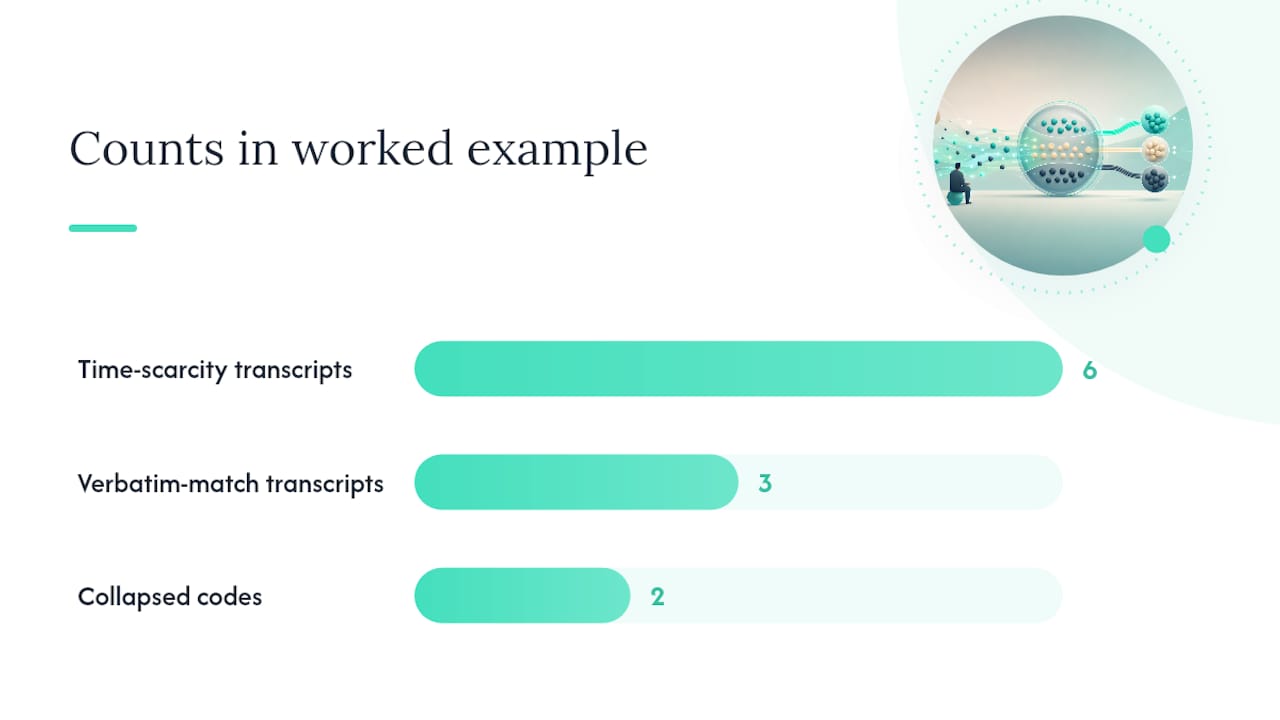
P03’s account surfaces a pattern appearing across at least six transcripts: time scarcity is not experienced as a personal failing but as a structural condition imposed by institutional demands. The in-vivo code “fire-fighting” captures the reactive quality of this experience better than any descriptive label I had drafted.
The axial code “paradox: seniority burden” emerged from collapsing two earlier codes (“increased responsibilities post-promotion” and “loss of protected time”). The decision to collapse was made on March 17, 2026, after P03’s account matched nearly verbatim language from P07 and P11. This convergence suggests the paradox is a shared structural experience, not idiosyncratic.
The emerging theme statement: Senior researchers experience a structural time paradox in which promotion increases institutional obligations while reducing the protected research time they expected seniority to provide.
Audit trail entry: March 17, 2026. Lead researcher. Collapsed two codes into “paradox: seniority burden.” Rationale: near-identical language across three transcripts; no analytic distinction between original codes. Affected files: Codebook v0.3, transcripts P03, P07, P11.
What experienced researchers actually prioritize
Transparency and reproducibility matter more than exhaustive coding. A codebook with 40 well-defined codes and a clear audit trail is more defensible than one with 120 codes and no documentation of how they were developed or collapsed.
Efficiency tips that actually work:
-
Pilot-code two transcripts before building the full codebook. You will catch definitional problems early, when fixing them is cheap.
-
Schedule calibration meetings every 3–4 transcripts, not just at the start and end of coding. Coder drift is gradual and invisible until it is too late.
-
Write memos during coding, not after. The insight you have at 11 PM while reading a transcript is gone by morning.
Short do-not-do list:
-
Do not over-code. Assigning 12 codes to a single paragraph produces noise, not nuance.
-
Do not skip memos because you are behind schedule. Memos are the analytic record. Without them, your audit trail is a list of decisions with no reasoning attached.
-
Do not treat saturation as a fixed number. It is a judgment call grounded in whether new transcripts are generating new codes.
Pro Tip: AI-assisted transcription and preliminary coding can cut hours of mechanical work, but human verification is non-negotiable for nuanced or high-stakes findings. Use automation to handle the first pass on transcription and to flag frequently occurring segments. Reserve your judgment for collapsing codes, writing theme statements, and deciding what the data actually means.
YumiLM cuts the time between raw audio and coded transcript
Researchers who spend 90 minutes manually transcribing a 60-minute interview before they can begin coding are losing time they cannot recover. YumiLM’s integrated workflow handles transcription, speaker labeling, and timestamping automatically, so you arrive at the coding stage with an editable, time-stamped transcript rather than a blank document.
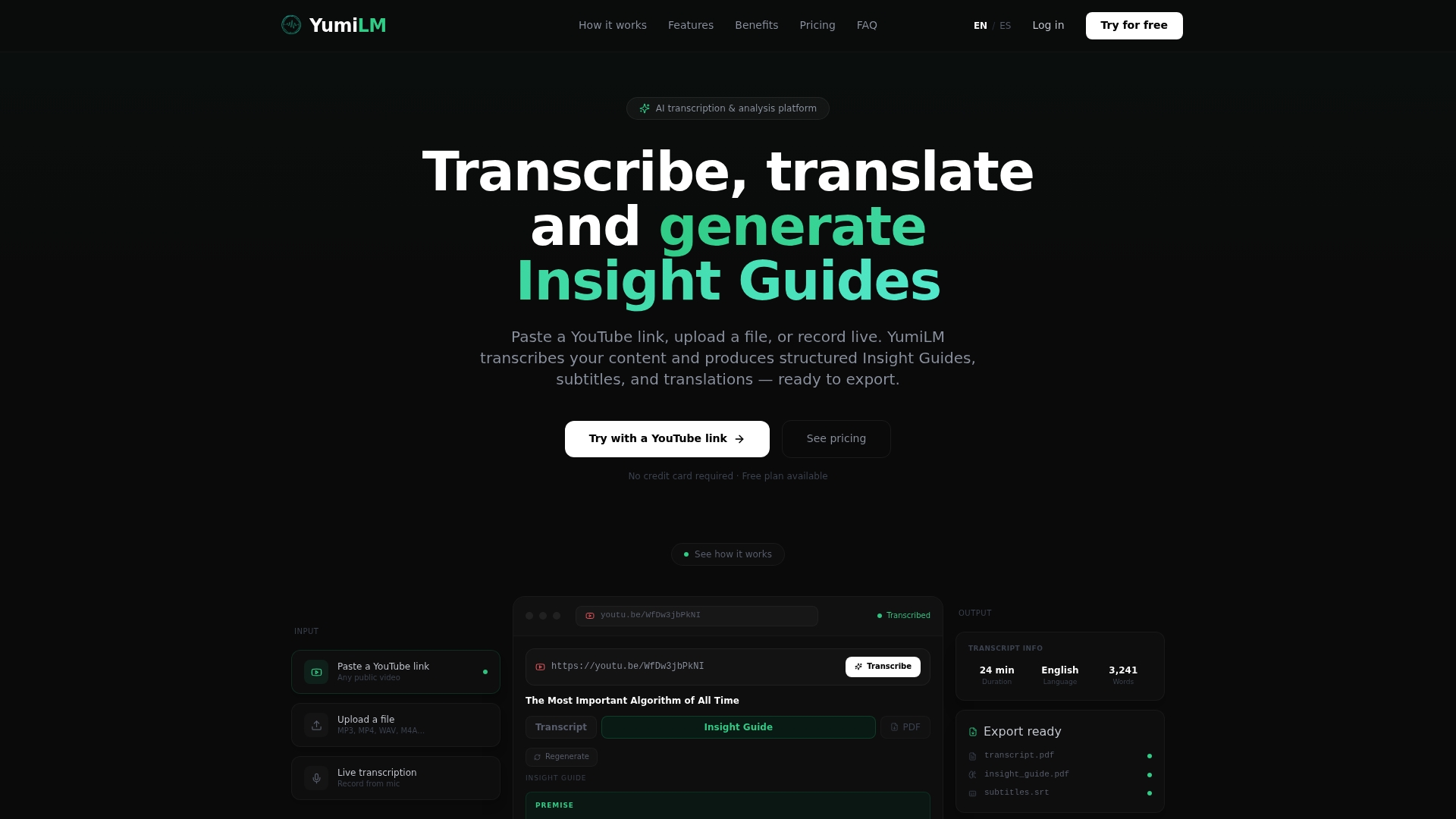
The research benefit is direct: time-stamped transcripts make quotes traceable to the second, which satisfies audit-trail requirements without extra manual logging. Exportable transcripts in standard formats keep your coded data portable across QDA platforms. The Insight Guide feature generates a structured synthesis of key concepts and moments, giving you a rapid first-pass orientation before you begin open coding. That orientation does not replace your analytic judgment; it compresses the time you spend on the initial read-and-memo stage.
Start with a 2–3 transcript pilot using your own interview audio at YumiLM, or read through the full transcription settings and export guide to confirm the workflow fits your IRB protocol before committing.
Sources
-
Frontiers | Qualitative data analysis: reflections, procedures, and some points for consideration
-
From Data Management to Actionable Findings: A Five-Phase Process of Qualitative Data Analysis