How to Write a Research Memo From a Video Recording
By the YumiLM Team
A research memo, sometimes called an analytic memo, is a written record of a researcher's thinking during qualitative data analysis: emerging ideas, questions, comparisons between codes, and reflections on what the data seems to be saying. It's not a summary of what happened in a session. It's a record of what the researcher made of it, written as the analysis develops rather than after the fact.
Memoing was formalized as part of grounded theory methodology and has since spread well beyond it, into thematic analysis, ethnography, and most qualitative traditions that involve coding data over time. When the underlying data is a video recording rather than live fieldnotes, the workflow changes in a specific way: you're no longer memoing from memory and hurried notes, you're memoing against a source you can replay, quote exactly, and check yourself against later.
Key Takeaways
| Point | Details |
|---|---|
| A memo is analysis, not summary | It captures the researcher's interpretation, questions, and emerging categories, not a description of what was said. |
| Origin in grounded theory | Formalized by Glaser and Strauss and elaborated by later grounded theorists (Corbin and Strauss, Charmaz); now used across most qualitative coding traditions. |
| Written throughout analysis, not at the end | Memos are dated, iterative entries, one whenever a code shifts, two categories seem related, or the data contradicts an earlier note. |
| Video changes the anchor, not the purpose | A recording lets you quote the transcript precisely and cite a timestamp instead of paraphrasing from memory, which live fieldnote memoing can't offer. |
| YumiLM supplies the transcript and a first-pass read | It doesn't write memos or code data, but its timestamped transcript and Insight Guide give an accurate source to quote from and an initial orientation before the real analytic work starts. |
Table of Contents
- What a Research Memo Actually Is
- Why a Video Recording Changes the Memoing Process
- Writing a Research Memo From a Video Recording, Step by Step
- What Belongs in a Memo, and What Doesn't
- Common Mistakes When Memoing From Recorded Data
- Where YumiLM Fits, and Where It Doesn't
- Frequently Asked Questions About Research Memos From Video
- Sources
What a Research Memo Actually Is
A research memo is a piece of analytic writing produced during, not after, qualitative data analysis. The University of Maryland Global Campus's guide to analytic memoing describes memo content as raising questions, making connections across the data, and working through the researcher's own reasoning, rather than restating what a participant said. That distinction is the whole point of the format: a transcript already records what happened; a memo records what the researcher is starting to think it means.
The practice comes out of grounded theory, where memoing sits between coding and writing up findings. As a session or interview is coded, the researcher writes memos whenever something in the data prompts a question, a comparison to an earlier session, or a hunch about an emerging category. Over a project, those memos accumulate into a record of how the analysis actually developed, not just its final conclusions. Delve's overview of analytical memos makes the same point from a practitioner angle: there's no fixed format, a memo can be a few sentences or several paragraphs, formal or conversational, and the value is in writing it down while the thought is still fresh rather than trying to reconstruct it later.
Memoing isn't exclusive to grounded theory. SimplyPsychology's guide to writing analytical research memos treats it as a general qualitative-analysis practice, useful in thematic analysis and other approaches that involve coding data iteratively, not a technique locked to one methodology.
Why a Video Recording Changes the Memoing Process
Memoing was originally built around live fieldwork: an interview, an observation session, a focus group, where the researcher takes notes in real time and writes memos from memory and those notes shortly afterward. That workflow has an obvious limitation, you're memoing against your recollection of what happened, filtered through whatever you managed to write down in the moment.
A recording removes that limitation, but it also changes what "good memoing" requires. With a transcript available, a memo that just paraphrases what was said adds little, the transcript already has that. What makes a memo useful now is that it can cite the data precisely: an exact quote, a specific timestamp, a direct comparison between two moments in the same recording or across recordings. The bar for a memo goes up because the source material is no longer the bottleneck, the researcher's ability to check their own interpretation against it is.
This also changes when memos get written. With live fieldwork, memoing happens close to the event, before memory fades. With a recording, a researcher can review the same segment multiple times across different coding passes, which means memos accumulate in layers, an initial impression on first pass, a revised or contradicting memo once a pattern shows up across several recordings, and so on. That layering is itself part of the analytic record, not something to clean up before writing the final report.
Writing a Research Memo From a Video Recording, Step by Step
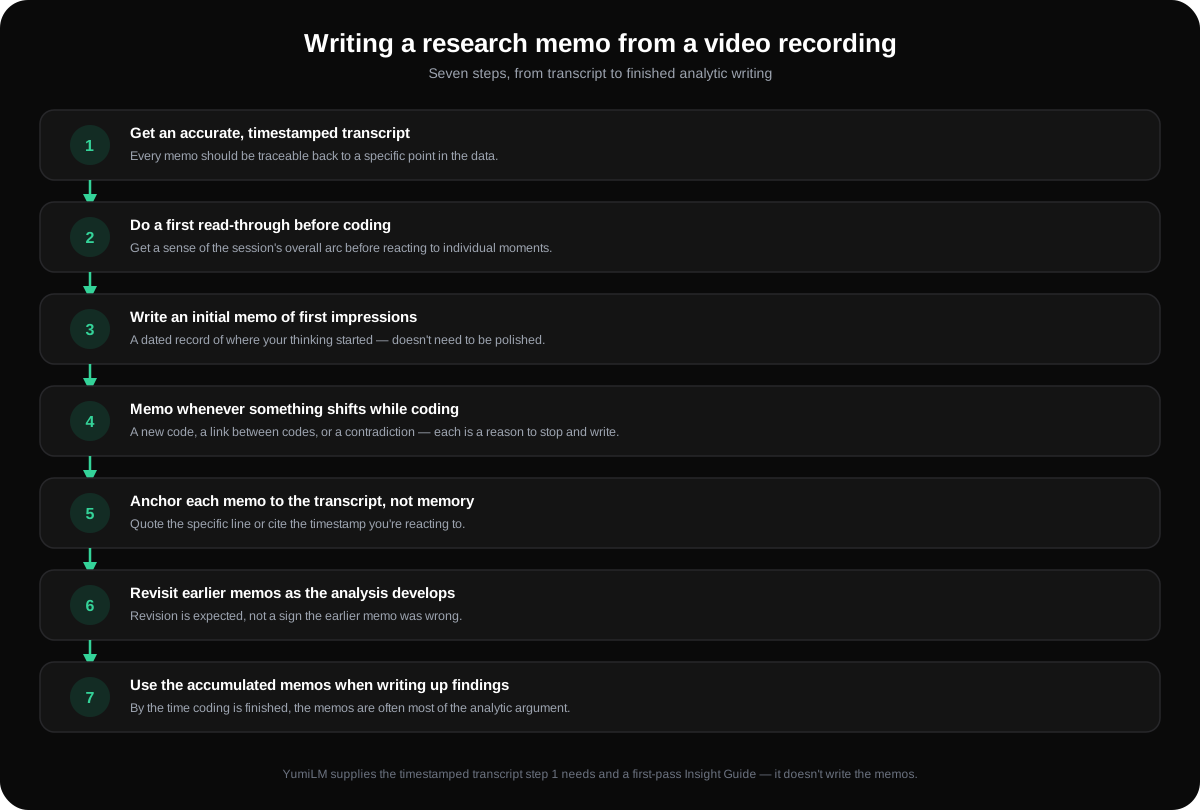
- Get an accurate, timestamped transcript of the recording. Every memo you write should be traceable back to a specific point in the data. A transcript that preserves timing makes that possible; one that doesn't forces you to re-scrub the video every time you want to verify a quote.
- Do a first read-through before coding or memoing anything. This orientation pass is about getting a sense of the session as a whole, its overall arc, before you start reacting to individual moments. Memoing line-by-line on a first pass tends to produce a pile of disconnected reactions instead of a coherent analytic thread.
- Write an initial memo capturing your first impressions. What stood out, what surprised you, what questions the session raises for the broader project. This entry doesn't need to be polished, it's a dated record of where your thinking started.
- As you code the transcript, memo whenever something shifts. A new code doesn't fit cleanly into existing ones, two codes start to look related, or a passage seems to contradict a pattern from an earlier recording, each of those is a reason to stop and write, not a distraction from coding.
- Anchor each memo to the transcript, not to memory. Quote the specific line or cite the timestamp you're reacting to. A memo that says "the participant seemed frustrated around 14 minutes in, when discussing X" can be checked later by anyone reading the analysis; one that just says "participants seemed frustrated" can't.
- Revisit earlier memos as the analysis develops. A memo written after the first recording might read differently after the fifth. Grounded theory treats this revision as expected, not a sign the earlier memo was wrong, memoing is meant to track how understanding changes across a project, not lock in a single reading.
- Use the accumulated memos when writing up findings. By the time coding is finished, the memos are often most of the analytic argument already written, in fragments. Drafting findings becomes a matter of organizing and connecting memos that already exist, rather than starting the interpretation from a blank page.
What Belongs in a Memo, and What Doesn't
| Belongs in the memo | Doesn't belong in the memo |
|---|---|
| Questions the data raises, even unresolved ones | A restatement of what was said, that's what the transcript is for |
| Comparisons between this recording and earlier ones | Verbatim long passages copied in without analytic comment |
| Emerging or shifting category names, with reasoning | A final, polished conclusion, memos are meant to be provisional |
| Specific quotes or timestamps that anchor a claim | Vague reactions with nothing in the data to check them against |
| The researcher's own reasoning, including doubts | Anything written purely to summarize for someone else's benefit |
Illustrative example
Transcript excerpt — 12:47
"...I mean, I only started trusting the new process after the second time it actually worked, not the first. The first time felt like luck."
Memo entry — dated, tied to 12:47
Trust here seems built on repeated confirmation, not a single success. Compare against P3's 09:15 mark, similar language ("second time"). Possible category: trust-through-repetition, not trust-through-explanation as I'd assumed after P1. Worth checking whether this holds for participants who abandoned the process instead of adopting it.
Illustrative example — not pulled from an actual research recording.
Common Mistakes When Memoing From Recorded Data
- Writing a summary instead of an analysis. Having a full transcript makes it easy to default to describing what happened. A memo that could be replaced by "re-read the transcript" isn't doing analytic work.
- Skipping timestamps and exact quotes. Without an anchor back to the source, a memo becomes unverifiable, both to the researcher revisiting it months later and to anyone checking the analysis afterward.
- Only memoing at the end of a project. Memoing is meant to track how thinking develops across the analysis. A single memo written after all coding is finished loses that developmental record, and tends to read as a conclusion dressed up as a memo.
- Treating an early memo as final. Grounded theory expects memos to be revised as more data is analyzed. Discarding or ignoring an earlier memo instead of updating it erases part of the analytic trail.
Where YumiLM Fits, and Where It Doesn't
YumiLM doesn't write research memos, code data, or identify emerging categories, that interpretive work stays with the researcher. What it provides are the two inputs the workflow above depends on: an accurate, timestamped transcript to quote and cite from directly, and an Insight Guide that lays out a premise, key points, and a conclusion, useful for the orientation pass in step 2, before the real memoing starts.
One limitation worth knowing before relying on it for multi-participant sessions: YumiLM's transcript is sequential timestamped text in the order it was spoken, without automatic speaker labels or diarization. If a memo needs to distinguish who said what in a group interview or focus group, that attribution has to come from the researcher listening alongside the transcript, not from a labeled transcript. For a single-participant recording, upload it or paste a YouTube link on the YouTube video to notes page to get the transcript and Insight Guide to memo from.
What it doesn't do: generate memos automatically, suggest codes or categories, or replace the iterative writing described above. A tool promising auto-generated qualitative codes or AI-written analytic memos is solving a different problem than a transcription and Insight Guide product, worth knowing before assuming it's the same category of tool.
Frequently Asked Questions About Research Memos From Video
Is a research memo the same thing as a summary of the recording? No. A summary describes what was said. A memo records the researcher's own analytic thinking, questions, emerging categories, comparisons, prompted by the data, which is a different kind of writing even when it references the same session.
Do I need to be using grounded theory specifically to write research memos? No. Memoing originated in grounded theory but is used across most qualitative coding traditions, including general thematic analysis, wherever a researcher is analyzing data iteratively over more than one sitting.
When should I write a memo, during coding or after? During. Memos are meant to capture thinking as it happens, a question that comes up mid-coding, a comparison that occurs to you between two recordings. Waiting until after coding is finished tends to produce a conclusion rather than a memo.
Should a memo quote the transcript directly? Yes, where possible. A memo that cites an exact quote or timestamp can be checked later against the source; one that paraphrases from memory can't, and loses value as a record of the analysis.
Does YumiLM identify who's speaking in a recording with multiple people? No. YumiLM's transcript is sequential timestamped text without automatic speaker labels, so attributing a specific line to a specific participant in a multi-person recording is something the researcher does by listening alongside the transcript, not something the product does automatically.
Does YumiLM write the research memo for me? No. YumiLM produces a transcript and an Insight Guide (premise, key points, conclusion), which give an accurate source to work from and an initial orientation. Writing the memo itself, the questions, comparisons, and emerging categories, is the researcher's analytic work.
Sources
- Guide to Analytic Memoing — University of Maryland Global Campus
- Writing Analytical Research Memos — SimplyPsychology
- Analytical Memos — Delve